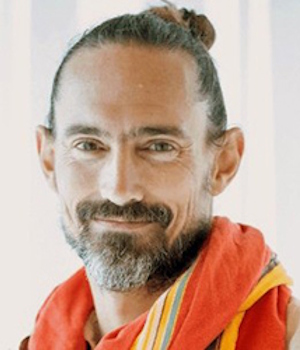
Whitney Wheelock
Co-Founder and Director of SKaSTA Tantra Yoga Ashram, India. In 2006 I traveled to Asia in search of myself and found Kaula Trika Tantra at Shri Kali Ashram where I studied and then taught until 2017. I continue to share this life changing perspective with others interested in exploring and celebrating unveiled REALITY.
My parents met in an esoteric spiritual community led by my grandmother, while also working as lawyers advocating for the rights of women and children. I grew up at the intersection of inner inquiry and community responsibility.
After working at the Federal Reserve Bank, managing at an international wine company, and living a successful modern life—I found myself deeply unfulfilled. Following the divorce from my wife at 26, I left America to play semi-professional football (soccer) in Germany, and eventually continued on to Asia in search of answers to my questions about life.
In 2006, a Tantra Yoga class in Thailand changed the course of my life. I began a one-month immersion which evolved into a decade of study, practice, and sharing the Kaula Trika Tantra tradition.
My life is now focused on authentic, honest, and playful celebration of life.
About SKaSTA Tantra Yoga Ashram
In 2006, Whitney joined Shri Kali Ashram and in 2017 he founded Sva-Tantra Ashram. In 2023, Shri Ma Kristina Baird and Whitney reunited and official merged Shri Kali Ashram and Sva-Tantra Ashram, SKaSTA Tantra Yoga Ashram was born.
At SKaSTA Tantra Yoga Ashram, our mission is to empower individuals to embrace life as sacred play. Rooted in the teachings of Kaula/Trika Tantra, which celebrate this world as the blissful Play of Devī, the Divine Feminine, we aim to create a sincere and inclusive community (Kula) where members can explore their divine nature and celebrate their infinite potentials (Svatantra). By integrating traditional and modern wisdom, we guide students on a transformative journey of self-discovery, connection, and celebration of the divine expressing Herself as You.
At SKaSTA we share tantric, ayurvedic and modern perspectives and practices which allow us to dis-cover our ānanda: ever-present innate bliss. We share through āsana practice, active dialogues on traditional tantric topics, modern communication/relating modalities, introspection practices and more to dis-cover our ānanda.
Traditional systems understand that consistent, repetitive practice quickly integrates new habits and perspective. This ancient knowledge has recently been confirmed by studies on neuroplasticity which show new neural habits can be formed within a few weeks/months by consistent and repetitive activity in a relaxed environment (see the work of Profs. Richard Davidson, Wisconsin University and Gerald Hüther, Göttingen University). Through the practices at SKaSTA you will optimize your prāņic (vital life force), hormonal, and neuralogical processes to support a life of expansion and celebration.
Tantra understands that you are the creator of your reality, more accurately, you are the blissful absolute celebrating life AS YOU. She/you chose to celebrate life here and now as this human being. Through prāņa optimising practices like āsana (physical postures), prāņāyāma (breathing practices), bandhas (internal contractions/holds), dhyānam (meditation), nyāsa (infusing the body with divine self-identity), etc. traditional tantra allows us to unveil ourselves and celebrate our innate bliss/ānanda/kāma.
At SKaSTA we share that all aspects of life—joyful or scary, mundane or exotic—are expressions of the Divine’s blissful play. This perspective empowers us to celebrate life as the microcosmic version of the universal play
Through Kaula Tantra tools and teachings, SKaSTA enables us to consciously re-condition and re-cognize our divine agency and infinite potential.
We explore the art of Nonviolent Communication (NVC) to foster PLAY i.e. self-responsibility, honesty, and compassionate connection. Through tools like ecstatic dance, body work, and Play, we cultivate awareness beyond intellectual understanding, encouraging a direct experience of prana, joy, and nonduality.
We celebrate life as Kula – a vibrant global community sharing traditional as well as contemporary practical knowledge, both in residence and online. Our Traditional Tantra Yoga Immersions are founded on decades of experience and certified by Yoga Alliance.
At SKaSTA, we offer a space for sincere, playful self-exploration and community connection, rooted in the wisdom of Śaiva-Śakta Tantra. Here Kula members engage in deep self-inquiry and embodied experience. Our teachings integrate tantric philosophy, mantra, puja, and āsana, emphasizing self-awarness as a lived reality. This is a journey of self-discovery, where all aspects of life: pleasure, pain, challenge, ease, dynamism and stillness are embraced as expressions of the Divine.
SKaSTA is home to a thriving residential community, where over half our members are returning alumni. We are also a global collective of affiliate schools and 1,000+ certified teachers worldwide.
What is Kaula Tantra?
Kaula Tantra is a Traditional Tantric philosophy from the monist perspective of Śaiva Tantra. Kaula Tantra holds that this entire experience of life is the projection of one blissful, playful, Divine consciousness.
Kaula Tantra integrates ritual, spiritual science, and direct experience to celebrate the Divine. This approach allows practitioners to use every aspect of life—including the body, senses, emotions, and environment—to recognize all experience as Divine
The information held in the Kaula Tantra system is meant to be lived, to be experienced in every moment of life. Kaula Tantra is a system of on action versus intellectualization. Eventually the worldview shared becomes intuitive, a superconscious flow rather than intellectual exercise or effort. Kaula Tantra sees every moment as sacred play; life as the dance of Shiva (foundational consciousness) and Shakti (playful dynamism) metamorphosing as each of us.
Through the view, that all is the play of one blissful consciousness embodied as everything, Kaula Tantra reminds practitioners of their divine potency (Svatantra) and how to recognise that potency in every moment.
Tantra Yoga in India: Finding Authentic Practice in the Land of Tradition
In a world where yoga has been commercialized and tantra often misrepresented, many seekers find themselves longing for something deeper—a connection to the authentic roots of these profound traditions. The journey toward becoming a tantra yoga teacher begins with finding genuine tantra yoga teacher training that honor the depth and transformative potential of traditional teachings. For serious practitioners looking to expand their understanding beyond modern interpretations, India remains the spiritual homeland where the essence of tantra yoga continues to thrive in sacred spaces preserved by living traditions.
Many yoga teachers and practitioners experience a spiritual thirst that standard studio classes and weekend workshops can’t quench. They sense there’s something more profound beneath the surface of familiar postures and breath work. This intuition is correct—traditional tantra yoga offers a comprehensive system for self-realization that integrates physical practices (āsana) with philosophy, ritual, and community (kula) living in ways that transform not just how we move on the mat but how we move about in life.
The Challenge of Finding Authentic Tantra Yoga
Today’s spiritual marketplace presents a paradox for sincere seekers. While „tantra” has become a buzzword appearing in countless retreats and workshops worldwide, authentic traditional tantra has become increasingly hard to find. Those searching for depth often encounter:
- Surface-level Tantra teachings that ignore lineage and depth
- Misunderstandings around sacred sexuality, identity, and spiritual practices
- Lack of integrated practice that includes ritual, mantra, and community
- Isolation in individual spiritual pursuits
- Āsana practice guided by prāṇic awareness rather than physical alignment alone
- Mantra recitation that connects practitioners to specific aspects of consciousness
- Ritual practices (pūjā) that honor the divine within and all around
- Nyāsa techniques that consecrate the body as a divine vehicle
- Community living (kula) that provides support for personal transformation
- Deep self-inquiry (ātma-vichāra) to recognize and release limiting beliefs
- Embodied practice that moves beyond conceptual understanding into direct experience
- Sacred study of traditional texts and their practical applications
- Ritualized transmission of teaching methods rooted in tradition
- Physical pleasure becomes a doorway to recognizing divine bliss
- Challenges and difficulties reveal themselves as opportunities for deepening awareness
- Relationships become mirrors reflecting our own divine nature
- Work and daily activities transform into sacred service and ritual